
Health management information systems versus fragmented tools: choosing the right approach for your hospital
Health management information helps Indian hospitals connect patient records, lab workflows, clinic operations, and billing in one integrated system.
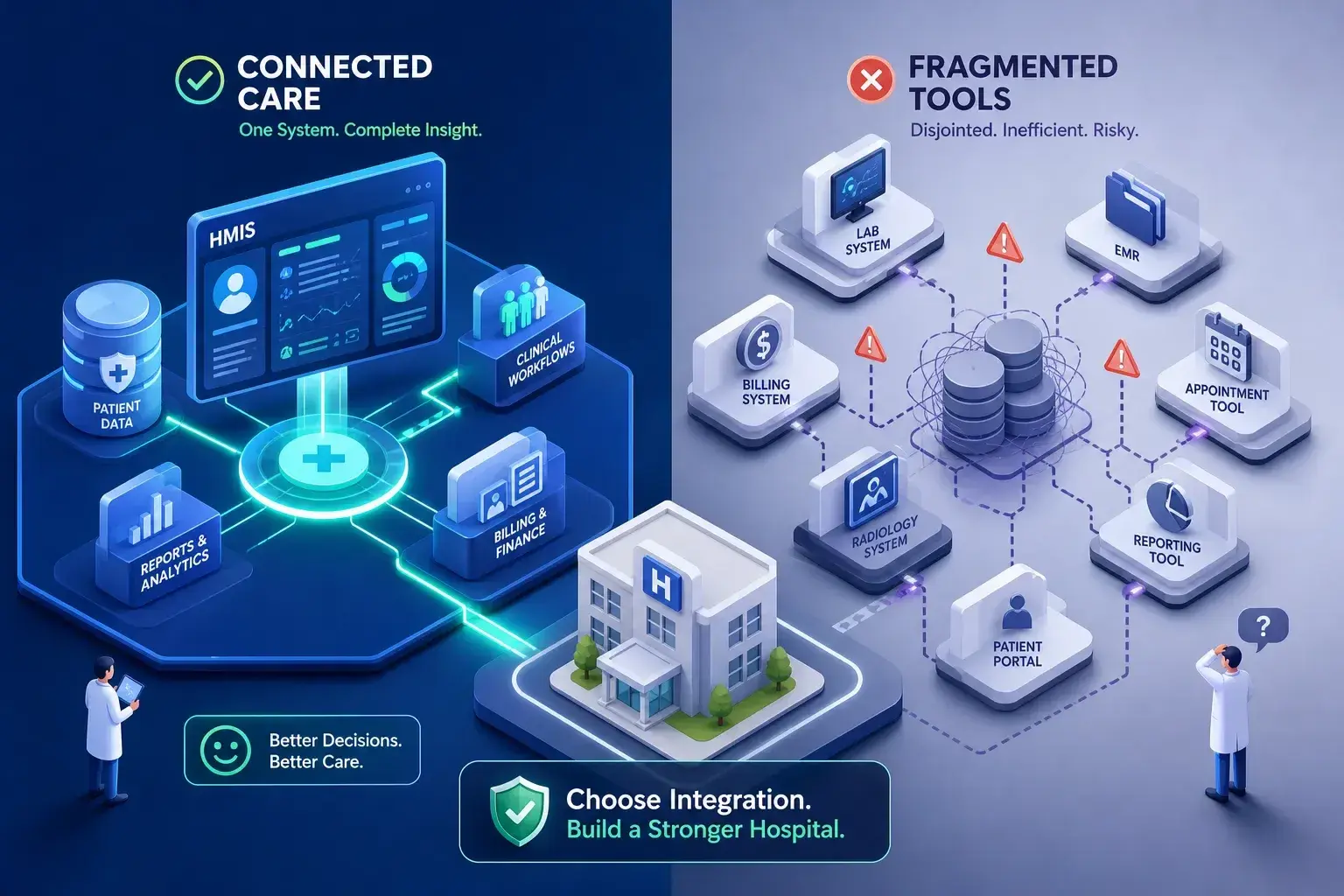
Health management information shapes how a patient's data flows from registration through to billing, yet many hospitals still depend on disconnected tools that create gaps at every step. Picture a patient who walks into registration at 9 am. By 9:15, their details are entered into the front-desk system. They walk to the lab counter, where a different system asks for the same details again. The phlebotomist draws samples, processes them, and prints a report. Someone carries that printout to the ward. The doctor types the results into their notes. By the time any of this is organised into billing, a chargeable item or two has been missed along the way.
This pattern is not a hypothetical failure. It is the direct result of building clinical operations on disconnected tools.
Health management information, at its core, is the organised collection, processing, and use of health data to support better decisions at every level of a facility. A proper health information system does not simply store records; it converts raw data into patterns that managers and clinicians can act on. Below, we cover what that discipline actually requires, how a platform like Nalam Software is built to support it, and the questions worth asking before you evaluate any implementation.
What health management information actually means
Most people use "HMIS" and "hospital software" interchangeably. They are not the same thing. A hospital software manages tasks; a health management information system manages decisions. The distinction matters because choosing the wrong one does not merely inconvenience your staff, it limits your ability to improve care over time.
The difference between data collection and decision-making
An HMIS collects data from every touchpoint, registration, labs, pharmacy, billing, and converts it into information that managers can act on. Raw numbers in a register are data. A dashboard showing that your lab turnaround time has been climbing over the past month is information that prompts action. The system's value is not in storing records; it is in surfacing patterns that would otherwise stay invisible.
Core components every HMIS must have
A functioning health information system has seven building blocks: governance and standards, a defined indicator set, multiple data sources (facility records, electronic health records, laboratory results, billing data), technology infrastructure, data-management processes, information products like dashboards and reports, and dissemination channels so the right people see the right data at the right time.
Strip out any one of these, and the system starts producing noise rather than insight. The data-management process component alone covers collection, entry, verification, aggregation, storage, and quality assurance, and each of those steps fails silently when disconnected tools handle them separately.
How a unified platform handles hospital, lab and clinic workflows
One setup to watch for in Indian hospitals is maintaining three separate systems: one for the hospital, one for the lab, and one, or just a notebook, for the clinic. Each generates its own data silo, and staff end up spending time bridging gaps between systems that should not exist.
Hospital module: from registration to discharge
A hospital management module should track the complete patient journey without manual handoffs. That means registration, with ABHA linking where applicable, at the front desk, appointment scheduling, ward admission, treatment documentation, discharge summary generation, and follow-up scheduling, all updating a single patient record. When a patient moves from OPD to IPD, no one should retype their details. Nalam Software's Hospital Management System is built on exactly this principle: the complete patient journey from registration through follow-up sits within one connected system.
Laboratory module: from sample collection to report delivery
A laboratory information system handles test registration, sample collection and tracking, instrument integration, result validation, and report delivery. In a connected HMIS, a doctor's test order in the OPD module automatically triggers a work order in the lab. The phlebotomist sees the pending collection on their screen, the lab technician processes it, and the validated report appears in the doctor's dashboard without a physical printout changing hands. A well-integrated laboratory module can substantially reduce manual transcription steps, shorten turnaround times, and minimise missing results when implemented correctly.
Clinic module: appointments to billing
For clinics, the priority is continuity. The system should link consultation notes, prescriptions, investigations, pharmacy dispensing, and billing into a single patient history. A doctor seeing a patient for the third time should be able to pull up the entire treatment timeline in one screen, not piece it together from three separate files. Nalam's Clinic Management System is designed to connect these elements and reduce gaps in multi-visit care plans.
Why integration and automation change your operational metrics
A unified health information system does more than reduce paperwork. It improves the numbers that matter to administrators and clinicians alike, and those improvements show up in the reports your team reviews every week.
Turnaround time and billing accuracy
When the lab module connects to the hospital module, test turnaround time drops because there are no manual transcription steps between the doctor's order and the lab worklist. When billing pulls data directly from pharmacy dispensing, ward charges, and lab reports, billing accuracy improves because chargeable items are less likely to fall off the invoice. Shorter turnaround times and more complete billing can materially affect a facility's revenue and cost recovery; quantifying the impact with your own operational data is the most reliable way to set realistic targets.
AI assistance and automated patient communication
Nalam Software includes an AI Assistance feature that lets users ask questions about their data in plain language and get answers, so a hospital manager does not have to pull a report manually. Automated WhatsApp communication is built into the platform so your organization can reach patients without switching tools. Common uses for this kind of messaging include appointment reminders, report-ready notifications, and discharge instructions. These features are designed to reduce administrative load and improve patient communication; evaluate their impact with a pilot and local metrics before projecting outcomes across your facility.
What India-specific compliance means for your HMIS choice
Choosing an HMIS in India is not only a functional decision; data protection and digital-health rules matter too. The compliance landscape is changing, and a platform that does not account for it can create legal and operational risk regardless of how well it handles clinical workflows.
ABDM, ABHA and EHR standards
The Ayushman Bharat Digital Mission (ABDM) aims to enable interoperability of health data and create longitudinal electronic health records. It is built around registries including the Ayushman Bharat Health Account (ABHA), the Healthcare Professionals Registry, the Health Facility Registry and a drug registry, and a growing number of facilities use ABDM-enabled software (PIB, February 2025). Requirements differ by facility type and by state. For example, the Secretary of the National Medical Commission has said that integrating hospital HMIS with ABDM platforms will be a mandatory requirement for medical-college-associated hospitals (PIB, April 2026). Check the current official guidance that applies to your hospital before choosing a system. As general technical considerations, if your facility joins ABDM, look for support for ABHA workflows, consent-based sharing of patient records, and standards-based interfaces such as HL7 FHIR, a standard for exchanging healthcare information electronically. This article does not claim that any specific product, including Nalam Software, is ABDM-certified; ask every vendor for its ABDM integration status and what has been certified.
DPDP Act, PM-JAY and data governance
The Digital Personal Data Protection Act, 2023 applies to digital personal data, which includes patient information, because it covers any data about an identifiable individual. It does not create a separate "sensitive" or health-data category, so health records are protected under the same duties as other personal data (DPDP Act, 2023, Gazette of India). Those duties for the organisation that decides how data is processed include processing on the basis of notice and consent or another lawful ground, taking reasonable security safeguards to prevent a personal data breach, informing the Data Protection Board and affected individuals of a breach, and erasing data once it is no longer needed unless retention is required by law. The Act's provisions come into force on dates notified by the Central Government, and the DPDP Rules, 2025, notified in November 2025, provide an eighteen-month period for phased compliance (PIB factsheet on the DPDP Rules). Confirm with your legal adviser which provisions apply to your facility at the time you read this. Measures such as role-based access and audit logs are sound security practice, but they are general good practice rather than specific requirements of the Act. An HMIS that does not support these data-protection duties can leave your facility exposed. Your legal adviser can confirm any other record-keeping rules that apply to your hospital.
How Nalam Software is built for these challenges
Consider an illustrative example: a 150-bed multi-specialty hospital running its laboratory, OPD, and billing on three separate systems. Lab reports are being printed, carried to the ward, and manually entered into billing. Errors creep in. Patients call the reception desk repeatedly to ask whether their reports are ready. This is a hypothetical scenario, not a Nalam customer case, but it illustrates the problem a connected, configurable platform is designed to solve.
Nalam Software connects workflows, teams, and patient information across hospital, laboratory, and clinic settings using AI-powered intelligence and automated WhatsApp communication. The platform covers the complete patient journey: from registration and appointments through admission, treatment, discharge, and follow-up on the hospital side; from test registration and sample collection through processing, validation, and report delivery on the lab side; and from consultation and prescriptions through pharmacy and billing on the clinic side.
What separates Nalam from a collection of generic tools is its configurability. The platform supports custom workflows, screens, fields, roles, dashboards, and integrations tailored to each facility's operational requirements. Facilities that need a unified system across hospital, laboratory, and clinic can run it that way. Those that need a single module can start there and expand. The AI assistance capability makes operational data accessible to managers without a report request cycle, and automated WhatsApp messaging handles routine patient communication without adding to the manual workload of staff.
Health management information: a practical checklist for evaluating an HMIS
Before you sign a contract or begin an implementation, your evaluation process should answer these eight questions clearly.
- Does the platform cover hospital, laboratory, and clinic workflows in a single connected system, or will you need separate tools that re-create the same data silos?
- If your facility joins ABDM, does the platform support ABHA linking, consent-based record sharing, and standards-based interfaces such as FHIR?
- Can it be configured to match your existing workflows without forcing you to rebuild your processes around the software?
- Does it include an offline or low-connectivity mode for uninterrupted operation during network disruptions?
- What automated communication features does it offer, and do they include WhatsApp integration for appointment reminders and report notifications?
- Can non-technical staff query operational data in plain language, or does every report require IT involvement?
- What is the vendor's approach to data migration, user training, and post-go-live support?
- How does the platform handle role-based access, audit logs, DPDP consent records, and breach notification workflows?
KPIs to track after go-live
Once your HMIS is live, measure performance across two categories. For service delivery, track bed occupancy rate, average length of stay, lab turnaround time, and billing accuracy rate. For health data management and quality, track reporting completeness (reports received divided by reports expected, multiplied by 100), reporting timeliness (reports received on time divided by reports expected), and the verification accuracy ratio (verified value divided by reported value, where a result of 1.00 means a perfect match). A well-configured HMIS surfaces these numbers automatically, without manual calculation or weekly report requests.
The decision is simpler than it looks
Choosing a connected health management information system over a collection of disconnected tools is not, at its heart, a technology question, it is a patient care question. Every manual handoff, every re-entered record, and every missed billing line represents time and money your facility cannot recover. The data exists in your systems; the question is whether your systems are designed to make it useful.
A connected HMIS works when modules share a common data architecture, when AI assistance makes operational data accessible to managers without a report request cycle, and when automation handles routine patient communication without adding to staff workload. Nalam Software is designed to connect modules, provide AI assistance, and offer automation features that address each of these requirements.
If you want to see how Nalam Software can be configured to match your facility's specific workflows, contact the Nalam team and request a demo. Bring your current process map; the team can walk you through exactly where the gaps are and how a connected platform addresses them.
FAQs
What is health management information?
Health management information is the organised collection, processing, and use of health data to support better decisions at every level of a facility. A health information system does more than store records; it turns raw data into patterns that managers and clinicians can act on.
What is the difference between HMIS and hospital software?
The article draws the distinction this way: hospital software manages tasks, while a health management information system manages decisions. An HMIS collects data from registration, labs, pharmacy and billing and converts it into information managers can act on.
What are the core components of an HMIS?
Seven building blocks: governance and standards, a defined indicator set, multiple data sources, technology infrastructure, data-management processes, information products such as dashboards and reports, and dissemination channels. Missing any one of them makes the system produce noise rather than insight.
How does connecting hospital, laboratory and clinic workflows help?
When modules are connected, a doctor's test order can create a work order in the lab, the validated report can reach the doctor's dashboard without a printout, and billing can draw on pharmacy, ward and lab data. That reduces manual transcription and the chance that a chargeable item is missed. The article advises measuring the impact with your own operational data.
What should I check before choosing an HMIS?
Check whether one system covers hospital, laboratory and clinic workflows, whether it can be configured to your existing processes, and, if ABDM applies to your facility, whether it supports ABDM, consent and data-protection workflows. Also ask about offline or low-connectivity operation, automated patient communication, plain-language data queries, and the vendor's approach to data migration, training and post-go-live support.
Which KPIs should I track after an HMIS goes live?
For service delivery, track bed occupancy rate, average length of stay, lab turnaround time and billing accuracy rate. For data management and quality, track reporting completeness, reporting timeliness and the verification accuracy ratio.
Which compliance areas should an Indian hospital review when selecting an HMIS?
Start with the Digital Personal Data Protection Act, 2023. It covers digital personal data, including patient information, and sets duties such as lawful processing with notice and consent, reasonable security safeguards and breach intimation. It does not define a separate health-data category. For ABDM, requirements differ by facility type and state; for example, the Secretary of the National Medical Commission has said ABDM integration will be mandatory for medical-college-associated hospitals. Requirements change, so check the current official guidance and confirm the position for your facility with your legal adviser.
Can a facility start with one Nalam module and expand later?
Yes. According to the article, facilities that need a unified system across hospital, laboratory and clinic can run it that way, and those that need a single module can start there and expand. The platform can also be configured with custom workflows, screens, fields, roles, dashboards and integrations.